Siem Reap
At the turn of the millennium Siem Reap was a Cambodian provincial town with few facilities, fewer surfaced roads and little in the way of nightlife. The tourism industry catered mainly to hardy backpackers willing to brave the tortuous road from the Thai border. The proximity of the Angkor ruins turned Siem Reap into a boomtown in less than half a decade. Huge, expensive hotels sprang up everywhere and the number of budget hotels mushroomed. Property |
values soared to European levels and tourism became a major source of income for local people. The Siem Reap of today is barely recognisable from the Siem Reap of the year 2000.
Though some of the town’s previous ramshackle charm may have been lost to development, this same development has brought wealth and livelihoods to many of Siem Reap’s citizens. Unfortunately this has been at a cost to the poor living in and around the town’s limits. Like most Cambodians, these people survive on poorly paid construction work or subsistence farming. Local wages have not kept pace with the inflated prices in Siem Reap’s markets. If Cambodia is a country of contrasts Siem Reap is the embodiment of those contrasts. Despite the massive shift in its economic fortunes, Siem Reap remains a safe, friendly and pleasant town. There is an endless choice of places to stay or dine, and a host of possible activities awaiting the visitor.
Things to See and Do
Wats and Shrines
Wat Bo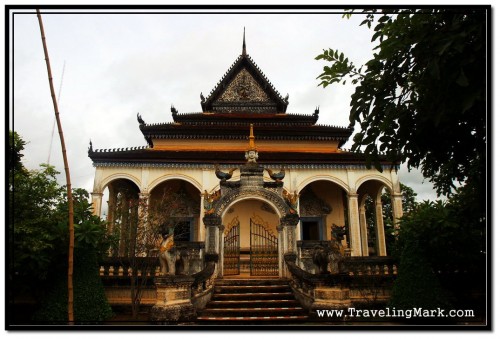
Wat Bo is the most historic structure in Siem Reap Province, other than the Angkorian ruins. It is located off Wat Bo Road and its quiet surroundings contain stupas, flowers and shrubs and the monks’living quarters. However, the main attraction at Wat Bo is wall paintings depicting the Ramayana and scenes from the life of the Buddha. The elegant style and subtle colours of the murals contrast sharply with the current vogue for bright, garish temple paintings.
Unfortunately, the poor condition of the building in which they are housed means that many scenes have already been damaged or destroyed by rainwater. While teams of specialists have rightly been dedicated to the preservation of the Angkor Temples, this treasure-trove of Khmer art is now at great risk.
Free Meditation and Conversation Sessions at Wat Bo
The monks at Wat Bo offer free meditation sessions from 4.00pm-5.00pm Friday-Sunday and hold informal conversation sessions about Buddhism and their daily life Monday- Thursday from 4.00pm-5.00pm.
For further information contact 012 756490 or ask at the Wat
[Siem Reap Map F-11].
Wat Thmei
 Wat Thmei (New Wat) The Wat contains a unique glass-walled stupa containing the bones of victims of the Khmer Rouge. Some of the bones were recovered from a nearby well, while others are the remains of soldiers who died on a nearby battlefield.
Located on the secondary road to the temples, 500m west of the road to Angkor about 1.5km north of town.
[Temple Map]
 Wat Damnak
Wat Damnak is also a very old temple and houses the Center for Khmer Studies (a public library) in its compound. There are also colonial style-buildings around the temple.
[Siem Reap Map B-15]
Shrines
Buddhism suffered repression during the war years. Religious beliefs of any kind were banned by the Khmer Rouge and anyone caught practicing a religious faith was persecuted. With the arrival of peace the Khmer people quickly set about building new temples, reviving old traditions, and celebrating the Buddhist holy days. Local shrines came back into use. Siem Reap has several important and interesting shrines two of these are located on National Road No.6, across from the Royal Residence.
Preah Ang Chek and Preah Ang Chorm
 This shrine holds two standing Buddha statues. The figures have great local significance and are believed to provide protection for the town. A local legend tells that Khmer Rouge cadres attempted to remove the two statues from the shrine, but the statues became heavier and heavier and the cadres were unable to lift them. Eventually they gave up and left the figures in situ.
Flowers and incense are sold from a stall in front of the shrine. A constant flow of visitors comes to pay homage and the shrine is often busy in the evening. The shrine to Preah Ang Chek and Preah Ang Chorm is considered a place of good fortune and it is common for newly-married couples and their families to visit the shrine. Wedding parties can often be seen outside.
[Siem Reap Map D-9]
Ya Tep
 Cambodia’s provinces and towns have their own local spirits and protectors. In Siem Reap, Ya Tep is a sort of ‘patron saint’ who is believed to have the power to protect travellers. The shrine dates back to the 18th century. It attracts local worshippers on a daily basis and is very busy during the principal Buddhist holy days. The shrine to Ya Tep is easy to find, being located on an island in the middle of National Road No.6, next to the Royal Residence.
[Siem Reap Map D-9]
Museums
Angkor National Museum 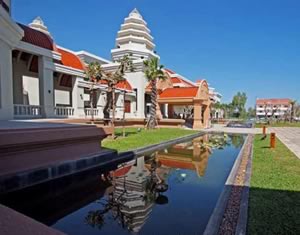
The new National Museum in Siem Reap has recently opened and features the Angkor National Museum itself plus a Cultural Mall and shops. The museum’s 8 main galleries contain original artifacts restored by Angkor Conservation and a collection of 1000 Buddha statues. Other galleries focus on ancient clothing styles; the four principal kings of Angkor; the extant written material from the Angkor temples and the history and religion of pre-Angkor period. Innovative mixed-media displays tell the story of the Angkor civilization and multi-lingual tour guides and audio units are also available. The Cultural Mall has souvenir shops selling high-quality reproductions of ancient artifacts as well as traditional silks and handicrafts. The Mall also contains restaurants, cafes and a garden area.
Mine Museum
Founded by 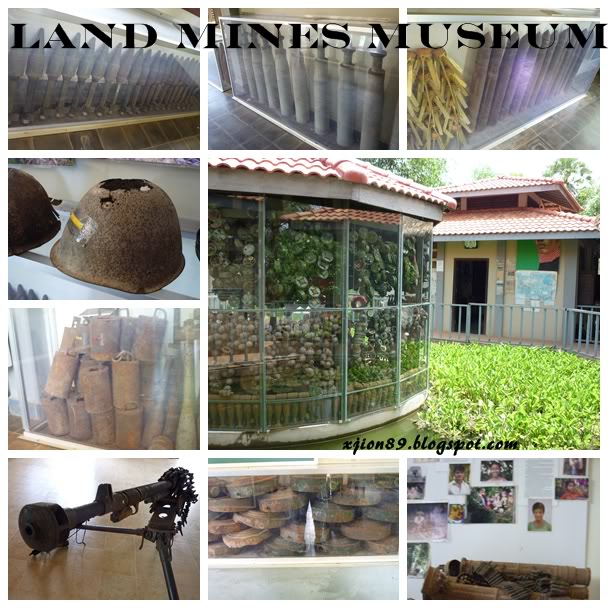 Mr. Akira, a former soldier and de-miner, this museum is a fascinating testament to Cambodia’s violent past, and to Aki Ra’s personal survival. It documents the story of Aki Ra’s life and experiences through a quarter of a century of war, and houses one of the world’s largest collections of decommissioned mines and other ordnance. Aki Ra is constantly seeking donations, and has recently founded an NGO, in cooperation with CLMMRF, to maximize his vision of “making my country safe for my people”. The museum is home to several young landmine victims taken in by Akira and his wife. This is a unique museum and a thoroughly worthwhile project that deserves your support. The museum is open from 7am to 6pm. Admission is free, but donations are gratefully accepted and much appreciated.
NOTE: The Mine Museum is now on the right hand side of the road leading from Siem Reap to Banteay Srey. Tel: 012-598 951
Cambodian Cultural Village
Owned by the Canadia Bank, the museum displays Cambodian history and culture in a kind of over-priced theme park [entry for foreigners is 6 times the local price]. Good displays of traditional dance performed with vigour and enthusiasm by the exponents. There is also a wax museum. Avoid the crass and distasteful Judgment Tunnel, especially if you have small children.
Admission: $2 for Khmer, $12 for foreigners.
Location: National Rd. #6 Tel: 012-368999, Tel/FAX: (855) 63-963836
War Museum
 A limited display of guns, mines, tanks and other military hardware. Open from 8am to 5:30pm. Entry costs $3. Do not confuse this museum with the Mine Museum.
Location: Kasekam Village off of National Rd. #6 on way to airport. Tel: 012-873 666
E-mail: warmuseum@forum.org.kh
Activities
Osmose: Trips to Prek Toal Core Bird Reserve
 Not far from the floating village of Prek Toal is the 22 thousand hectare core bird reserve, part of the UNESCO declared Tonle Sap Great Lake Biosphere Reserve. Ariel surveys in the nineties revealed significant breeding colonies of large water birds extinct else where in South East Asia with seven species in particular: Oriental Darter, Spot Billed Pelican, Greater and Lesser Adjutant, Painted and Milky Stork and Black Headed Ibis. Thanks to the efforts of the WCS Rangers (Wildlife Conservation Society) the numbers of breeding pairs of these species has increased in the last 6 years. The birds nest in the reserve from September through March which corresponds with the flood of the lake from the back flow of the Mekong up the Tonle Sap River. During this time the reserve becomes accessible by boat. OSMOSE, a local NGO working in environmental education and
  conservation, runs trips to the core reserve in cooperation with the Environmental Research Station in Prek Toal. The visits are a must for any keen bird watcher visiting Siem Reap, and also for those who appreciate the beauty of an unspoiled wilderness. It also offers the opportunity to experience the floating village close up during a paddle boat tour of Prek Toal.
For more information, or to book a trip, contact OSMOSE at 012-832812, or osmose@online.com.kh
